
Emergency Air Duct Cleaning Near Me: What Louisville Homeowners Should Do First
If you’ve just had a basement flood, found an animal in a return duct, or dealt with smoke from an HVAC fire, the first move is not to call a cleaner. It’s to shut the system down so contaminated air stops moving through your house. Once the blower is off and the thermostat is at OFF, then you call. If you’d rather have a pro walk you through it, call (866) 875-5603.
Most people call the first number that advertises “emergency” service and skip the shutoff entirely. That instinct is understandable. It’s also how a contaminated duct system ends up spreading soot or flood residue into every room before a single piece of equipment is unloaded. This guide covers what to do in the first hour, what to ask before anyone arrives, and how to tell a real duct emergency from something that can wait until morning.
What Actually Counts as an Air Duct Emergency?
Three situations are genuine emergencies: flood or sewage intrusion into the ductwork, an animal intrusion or death inside a duct, and fire or smoke damage that pulled combustion byproduct into the system. Everything else can usually wait for a scheduled appointment. The distinction matters because emergency response looks different from routine cleaning, and not every duct company is set up for it.
Here’s how the three break down:
- Flood or sewage intrusion. Standing water in a duct means the liner is soaked, and porous materials can support biological growth within a day or two. Air moving through those ducts carries that contamination into living space. This is the one that cannot sit.
- Animal intrusion or death. A dead animal in a return duct is a genuine air-quality event, and rodents chewing through duct insulation can leave gaps that pull attic or crawlspace air into the system. Odor is the obvious symptom; compromised duct integrity is the quiet one.
- Fire or smoke damage. Smoke residue in ductwork can be acidic and corrosive to metal components, and combustion particles are fine enough to travel the whole system. This is a contamination cleanup, not a standard cleaning.
Situations that feel urgent but generally can wait: a dusty smell when the heat first kicks on, visible dust on a return grille, a dryer that’s taking two cycles instead of one, or a mild musty odor with no water event behind it. Those are worth scheduling, but they aren’t emergencies. For routine service, our air duct cleaning page covers what a standard appointment involves.
The First Hour: What to Do Before Anyone Arrives
Shut the system down and keep it down. Turn the thermostat to OFF and, if you can safely reach it, flip the breaker that feeds the air handler. With the blower stopped, contaminated air stops circulating. That single step buys you time and limits the spread while you sort out who to call.
Then work through this sequence:
- Stop the source. If water is still entering, shut it off. If there’s an animal in the system, don’t run anything that could move it.
- Don’t run the fan. No “fan on” setting, no temporary cooling. A running blower is a distribution system for whatever is in the ducts.
- Seal the obvious openings. Tape plastic over the supply and return grilles in the affected area if smoke, odor or visible contamination is present. This reduces cross-migration while you wait.
- Keep people out of the affected rooms. If there’s smoke residue or sewage contamination, close the doors and keep children and pets away.
- Document what you see. Photos of standing water, the animal, soot patterns or visible debris help the technician scope the job accurately and help your insurer if a claim is involved.
- Call a company equipped for containment, not just vacuuming. More on what that means below.
If the contamination is sewage or involves significant water, your Louisville home may also need a restoration contractor for the structural water damage. Duct cleaning handles the air system; it doesn’t dry a soaked subfloor.
What to Ask Before You Let an “Emergency” Duct Company In
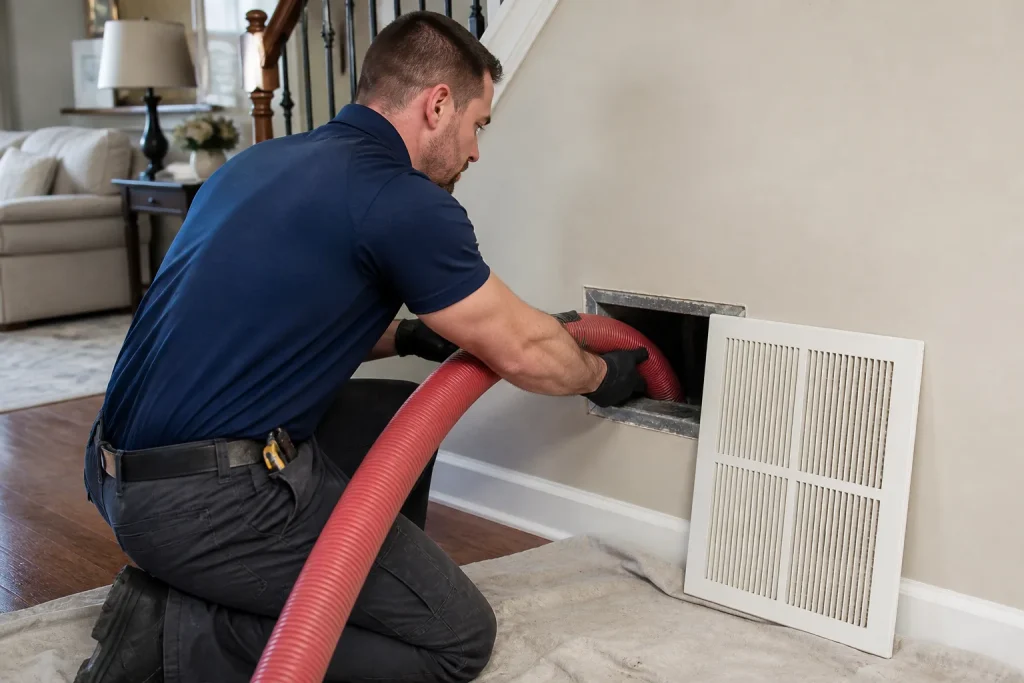
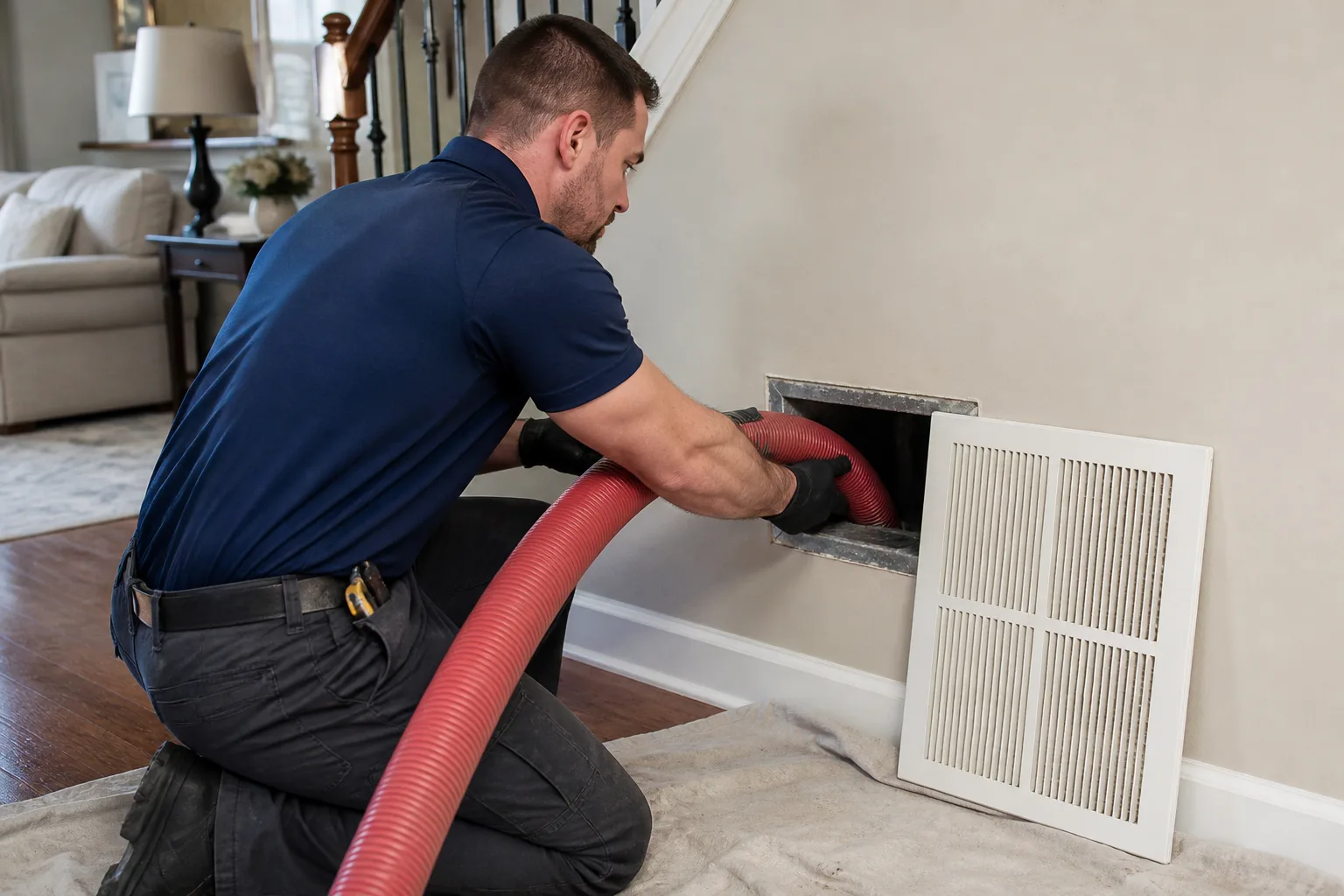
Ask two questions: do they use negative pressure containment, and what equipment are they bringing for contamination events? A company that answers confidently and specifically is set up for this. A company that says “we’ll just vacuum it out” is not. Containment is what keeps the contamination from migrating into the rest of the house during the cleaning itself.
Negative pressure means the work area is held at lower pressure than surrounding rooms so air flows inward, toward the collection equipment, rather than escaping into the home. In our experience, this is where emergency and standard cleaning part ways. Standard cleaning collects debris. Contamination response contains it first and cleans second. The equipment matters too: commercial-grade systems and HEPA filtration, not a shop vac with a long hose.
Ask specifically about:
- Negative pressure setup. Do they seal and draw the work zone under negative pressure before starting?
- Filtration rating. HEPA-level filtration on collection equipment, not just a filter bag.
- Biocide-rated or antimicrobial handling for biological contamination events, when appropriate to the situation.
- Rotobrush or Nikro equipment, or comparable professional systems used by restoration contractors rather than consumer blowers.
- Whether they also repair ductwork. A contaminated event can compromise the ducts themselves. If they only clean, you may need a second call.
We run professional-grade equipment from Rotobrush and Nikro, and Abatement Technologies containment gear, because contamination jobs call for exactly that. It’s the difference between cleaning a system and protecting a home while you do it.
Louisville Storm Season and What Storm Debris in Ducts Looks Like
Louisville’s spring and summer storm season, including tornado warnings and the straight-line wind events that follow, drives a specific kind of call: shingle grit, insulation fibers and fine roof debris pulled into the system through compromised connections or attic returns. It doesn’t look dramatic. It looks like a fine gray-brown dust coating the inside of the return, sometimes with fiberglass strands visible in the register boot.
What most homeowners miss is that storm debris entering the ducts usually means something upstream is open that shouldn’t be. A cracked return plenum, a disconnected flex run in the attic, a damaged boot at the ceiling. Cleaning the debris without sealing the opening just means it comes back with the next storm. This is where cleaning and repair have to be considered together. We handle both, which is why a single call can close the gap rather than just clear it. If you’ve had roof or attic damage from a storm, it’s worth having the duct connections checked even if the air still feels fine. Our Thrive Air Duct Cleaning team can assess both the contamination and the duct integrity in one visit.
Emergency Cleaning vs. Emergency Duct Repair: Why the Difference Matters
Sometimes the ducts need repair before they can be safely run again, and cleaning alone won’t fix it. Animal intrusion, storm damage and water events can all compromise duct integrity: crushed flex runs, separated joints, torn liner, or gaps at the plenum. Running the system with an open duct pulls unconditioned attic or crawlspace air straight into your living space. That’s a repair problem, and it comes before cleaning.
Here’s the short version of when each applies:
- Cleaning alone handles contamination in an otherwise sound system: flood residue, smoke, animal odor, storm dust.
- Repair first, then clean applies when the ducts are physically compromised and running the system would pull outside air in. Gaps get sealed, runs get reconnected, then the system gets cleaned.
- Both, in one scope is what a genuine contamination event usually needs. Cleaning without repair leaves the opening. Repair without cleaning leaves the contamination.
Ask any company you call whether they do duct repair. If the answer is no, ask who they’d refer you to, and expect a second appointment and a second invoice. Thrive does cleaning, repair, and dryer vent cleaning, so the whole air system gets assessed at once.
When to Call a Pro (and When to Wait Until Morning)
Call now for flood or sewage intrusion, an animal in the system, or fire and smoke damage. Wait for a scheduled appointment for dust, mild odor, or a dryer running long. Our technicians have up to 10 years of experience, and a quick phone conversation is usually enough to sort which category you’re in. Better a two-minute call than an unnecessary emergency visit or a delayed real one.
Related services in Louisville: air duct cleaning, air duct repair, and dryer vent cleaning. If you’re not sure which applies, describe what happened and we’ll point you the right way.
Ready to schedule or need to talk it through? Call (866) 875-5603. We answer 24/7. Fast dispatch from 7am to 7pm, Sunday through Friday.
The Bottom Line
Genuine duct emergencies are flood or sewage intrusion, animal intrusion, and fire or smoke damage. Everything else can wait for a scheduled visit. In the first hour, shut the system off at the thermostat and breaker, seal the affected grilles if contamination is present, keep people out of the affected rooms, and document what you see. Then call a company that uses negative pressure containment and professional-grade equipment, and ask whether they also repair ductwork, because some events need sealing before the system is safe to run again.
Don’t assume the company advertising the loudest “emergency” response is equipped for contamination. Ask about containment. If they can’t answer, keep calling. If you’re in Louisville and need help, Thrive Air Duct Cleaning offers free estimates. Call (866) 875-5603. We answer 24/7. Fast dispatch from 7am to 7pm, Sunday through Friday.
Frequently Asked Questions
There’s no standard flat emergency price, because cost depends on the scope of contamination, square footage of the system, and whether duct repair is needed. A flood or smoke event typically costs more than a standard cleaning because containment and filtration add time and equipment. We give a written estimate before any work starts, so the price you agree to is the price you pay. Call (866) 875-5603 for an exact quote. Estimates are free.
No. Running the fan circulates whatever is in the ducts through every room fed by that system. If you have smoke, sewage contamination, or an animal in the return, keep the thermostat at OFF and, if you can safely reach it, shut the breaker to the air handler. The system stays off until a technician has assessed it.
Signs include visible gaps at joints, crushed or disconnected flex runs in the attic, torn liner, or a return that’s pulling air from an unconditioned space. If the system is compromised, running it pulls outside air in, and cleaning before sealing doesn’t solve the problem. A technician checks duct integrity before cleaning starts. Ask any company upfront whether they handle repair as well as cleaning.
It’s a genuine air-quality event and worth same-day attention, especially if children, pets or anyone with respiratory sensitivity lives in the home. Once the animal is removed and the system is sealed off from the source, cleaning and odor treatment can follow on a scheduled basis. The priority is stopping the source, then containing, then cleaning. Call (866) 875-5603 to sort out the right sequence for your situation. We answer 24/7.
Written by the team at Thrive Air Duct Cleaning.
Need Air Duct Cleaning Help?
Call Thrive Air Duct Cleaning - licensed & insured, with free written estimates in Louisville.
(866) 875-5603